
Income that is parental income
The following sections provide advice on income that is included in a parental income assessment.
Taxable income
Any payment or money received that is taxable (i.e. a parent is liable to pay tax on it) is parental income for Student Allowances.
Wages and salary
The gross amount of any wages or salary a parent receives is parental income (whether taxable or not).
Wages and salary includes paid parental leave, weekly accident insurance payments and overseas wages and salaries.
Allowances paid to parents by an employer are only considered income where taxable.
Benefit income
The gross amount of any income received from an income tested benefit is parental income. This is for main benefits only, not extra help.
Interest
Gross interest earned from any source.
Dividends
Dividends are part of a company's profits that is passed on to its shareholders.
Company profits are paid to shareholders according to the proportion of the company they own.
Business income
Business income in general terms is the income that owners of a business get from that business.
From a technical or legal perspective, for the purposes of Family Scheme Income under the Income Tax Act 2007, business income is defined as the net income of the business. Net income is the annual gross income less any permitted deductions.
- if, for a tax year, a person's annual gross income is more than their annual total deduction, the difference is their net income for the year
- if, for a tax year, a person's annual gross income equals their annual total deduction, their net income for the year is zero
- if, for a tax year, a person's annual total deduction is more than their annual gross income, the difference is their net loss for the year, and their net income for the year is zero
The 'net income' amount is before any business (or tax) losses are included in order to determine a person's taxable income. Business (or tax) losses include losses brought forward.
For income tax, an individual may offset any business (or tax) losses against their other taxable income. But, for parental income, when a business loss occurs, generally it is ignored and therefore cannot be offset against other forms of income.
If a parent has separate business or investment activities which are normally carried out in association with each other, a loss can be off-set from one business or investment activity against another.
When deciding if this provision applies, firstly it needs to be confirmed that both activities are active through the same legal personality (i.e. a trust cannot have its loss offset against a partnership or a company as they would be owned by separate legal personalities).
Secondly, it would need to be confirmed that the activities are normally carried on in association with each other. Associated business activities are ones that are connected, joint or combined in relation to the activities themselves, not the ownership structure. For this association to be confirmed, the activities must only operate in association with each other and not have any other business activities occurring.
For example, a parent has a loss from their landscaping partnership of $7,500. They have also made a profit from a lawn-mowing partnership of $50,000. These 2 partnerships only operate in conjunction with each other. The activities are owned by the same legal personality and are carried out in association with each other, so the $7,500 loss can be off-set against the $50,000 profit.
The legal authority for determining whether separate businesses or investment activities "...are of the kind that are normally carried on in association with each other" is given to the Commissioner of Inland Revenue under section MB 3(3) of the Income Tax Act 2007. If there is doubt in a particular case, the case or situation can be raised with Inland Revenue for a decision.
If a decision is made by Inland Revenue in a specific case, then that decision is generally not covered by the review and appeal provisions under the Education and Training Act 2020.
Drawings
Drawings is the term used in financial accounts to describe money withdrawn from a business or a company by the owners or shareholders.
Drawings cannot be taken from a trust. Payments of this type are either a beneficiary distribution, a trustee loan or a tax free distribution which is used for private living expenses.
Drawings are by definition not money intended to be used for the use of the 'business' it is drawn from, so should generally be included as income for the purposes of calculating parental income for Student Allowances.
In some cases it would be more accurate to categorise these payment(s) as either a shareholder wage or salary, or a dividend payment.
Accountants may not always label drawings in an easily identifiable way (e.g. they could be described as a donation, taxation or insurance payments).
Generally it is the purpose or intended use of the money (i.e. the substance of the transaction) that will determine whether it is parental income for Student Allowances.
Firstly it needs to be determined whether the drawings payments are some form of income, dividend or salary that has been miscoded in financial statements.
Secondly, it should be determined if the drawings fall under any of the exemptions as outlined in Income that is not parental income.
Some examples of types of drawings that are considered parental income based on the purposes or intended use include:
- where a payment is 'coded' in the business accounts of a parent as 'drawings' where it should be (based on its source and use) categorised as a payment of shareholder salary, a dividend payment, a loan (other than a loan made on ordinary commercial terms and conditions which is not parental income) or in the case of a trust a beneficiary distribution or loan
- where a capital contribution is made to a business entity. Subsequently a drawing is made that is described as being a drawing down of all or part of that capital amount, but it is for personal use (i.e. income related)
- where the payment(s) meet the definition of 'Payments for income related purposes where the total exceeds $5000 a year'
In respect of the capital contribution described above, from the 2015/2016 tax year and onwards payments from a parent's capital ownership of an investment activity or business that:
- are not payments by a trustee and
- are received on capital account and
- are not a loan
are not parental income.
As this applies from the 2015/2016 tax year and onwards, it means any assessments of the parental income where the relevant tax year is 1 April 2015 - 31 March 2016 (or a later tax year) must apply the new policy.
These payments are in effect reducing an asset. E.g. taking money from a savings account.
The Student Allowance parental income test is not an asset test.
Retirement savings income
Payments received from retirement savings are generally parental income for Student Allowances. See below for a description of different types of retirement savings income and advice on when this should be included as parental income.
Income, pensions or annuities from a life insurance policy or private superannuation fund
Half of any payment received in the form of a pension/annuity from a private superannuation fund or a pension/annuity under a life insurance policy is parental income for Student Allowances.
New Zealand Superannuation is not a private superannuation scheme and therefore all the income received for New Zealand Superannuation is parental income for Student Allowances.
When the pension or annuity is a regular ongoing payment, i.e. unless it represents a regular ongoing payment, a lump sum payment is not generally considered to be parental income, but may fall into the 'Distribution from superannuation schemes' or 'Distributions from retirement savings schemes' categories described below.
The Government Superannuation Fund (GSF) was established in 1948 to provide a way for state sector employees to save for their retirement. GSF is a private superannuation fund and therefore half of any payments received from this fund are parental income for Student Allowance purposes. The fund was closed to new members in 1992.
Distributions from superannuation schemes
The amount of any distribution received by a parent from a superannuation scheme will be included as parental income if:
- an employer of the parent has made contributions to the scheme in the income year in which the distribution was received or the 2 years immediately prior and
- the parent continues to work for the employer for 1 month or more after the date of the distribution
Only the employer contributions received are assessed as parental income (not the returned contributions that the parent made as a member of the scheme). The employer contributions are divided into the years that the contributions were made and, for assessment purposes, allocated to those years. Where the distribution is allocated to the relevant tax year, the income is included as parental income for that tax year.
Distributions from KiwiSaver schemes or a complying superannuation fund are not included as parental income for Student Allowance purposes unless the next paragraph applies.
If the parent receives a pension or annuity from a superannuation scheme as a result of or after their retirement from employment from the employer, (who contributed to the scheme), half of the pension or annuity is included under the category 'Income from a life insurance policy or private superannuation fund' (see above).
Distributions from retirement savings schemes
The amount of any distribution received by a parent from a retirement savings scheme will be included as parental income for Student Allowances if:
- retirement savings scheme contribution tax was not paid by the contributor when the contributions were made and
- at the time of the distribution, the parent is not eligible for New Zealand Superannuation
The amount to be assessed as parental income is the amount distributed to the parent.
Overseas pensions
The amount of any overseas pension (taxable and non-taxable) received by a parent is parental income for Student Allowances.
Income of major shareholders in a closely held company
From the 2014/2015 tax year onwards, if a parent is a major shareholder in a closely held company the amount of income that is parental income for Student Allowances is the greater of either zero or the amount calculated using the following formula.

For the purpose of this formula, the following definitions apply:
parent's interest is the percentage voting interests for the company held, on the last day of the company's income year, by the parent
income is the net income of the company for the company's income year
dividends is the total dividends paid by the company for the company's income year
Attributed interest is calculated using the following formula:
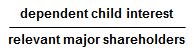
For the purposes of this second formula, the following definitions apply:
dependent child interest is the total percentage voting interests for the company held, on the last day of the company's income year, by:
- the person's dependent children (as the term is defined in the Income Tax Act 2007) and
- dependent children of the person's spouse, civil union partner or de facto partner
relevant major shareholders is the total number of the following people who are major shareholders of the company on the last day of the company's income year:
- the person
- the person's spouse, civil union partner or de facto partner
- principal caregivers of the dependent children described above
This policy allocates any shares held by dependent children to the parents, for the purposes of apportioning any income that may be earned from them to the parents.
It is designed to prevent a parent artificially reducing their income by the mechanism of allocating shares to a dependent child.

Attributable trustee income
For a settlor of a trust, attributable trustee income is all income for the year of a trust that has not been distributed as beneficiary income. It includes income from trading and investment activities and the net income of any companies controlled by the trust.
Attributable trustee income that a parent receives from a trust, as a settlor of the trust, is parental income for Student Allowances, unless:
- the trustee of the trust is registered as a charitable entity under the Charities Act 2005
- the trust is solely for the benefit of a local authority
- the interest and dividends derived is for funeral costs
- the trust is a superannuation fund
- the parent (or a member of their family) is not permitted to benefit from the trust except under an order of a court
In determining attributable trustee income, this may require confirmation of who the settlors of the trust are. This may be required to determine:
- whether the parents are the settlors of the trust and
- how the attributable trustee income should be apportioned including where there are other settlors in addition to any parents
From the 2014/2015 tax year onwards, the attribution of trust income to settlors can only occur in relation to settlors that are alive in the income year.
Attributable fringe benefits received by shareholder employees
Where a parent who is a shareholding employee of a company and holds:
- voting interests of 50% or more and/or
- market value interests of 50% or more (if market value circumstances exist)
the taxable value of any fringe benefits received is parental income for Student Allowances.
Portfolio Investment Entity (PIE) income that is not 'locked in'
Any amount of income that is included in a tax return by a Portfolio Investment Entity to a parent, is parental income for Student Allowances, unless it is a 'locked in' superannuation fund or a retirement savings scheme.
If the income is from a superannuation fund or a retirement savings scheme, the Superannuation Scheme and Retirement schemes rules apply as noted above.
Tax exempt income
When a parent (who is a New Zealand tax resident) receives income that is exempt from tax in New Zealand, that income is parental income for Student Allowances purposes.
This includes:
- salary and wages that are exempt from income tax under specific international agreements in New Zealand
- employees of international organisations such as the United Nations or the Organisation for Economic Co-operation and Development (OECD), or under the Diplomatic Privileges and Immunities Act 1968
Income equalisation scheme deposits and withdrawals
Main income equalisation schemes
Deposits made into a main income equalisation scheme are parental income for Student Allowance purposes.
Any withdrawals from the scheme are not parental income (however any interest earned on the deposit is parental income once withdrawn).
For income tax purposes all deposits to all schemes are ignored and the withdrawals are taxable.
Adverse events and forestry thinning operations income equalisations schemes
Withdrawals from adverse events income equalisation schemes and forestry thinning operations income equalisation schemes are parental income as they are taxable. Deposits are not parental income.
Income from board
Any taxable income that a parent receives from board payments is parental income for Student Allowance purposes.
A parent is required to declare any taxable income they receive from boarders to Inland Revenue.
The Inland Revenue website outlines what amount of any declared boarding payments are deemed to be taxable. This amount will depend on the costs they incur and the boarding payments they receive.
Information on when a person is required to pay tax on income from boarders is available from Inland Revenue
Income from rental properties
Income from rental properties that are part of a Business or Trust, must be included in any Business or Family Trust income declared.
Income from rental properties not part of a Business or Trust must be declared to Inland Revenue. This income will be included in any taxable income declared.
Motor vehicle
From the 2014/2015 tax year onwards, if a parent agrees to a lower salary in exchange for use of a company motor vehicle, the amount of reduction in the salary is parental income.
Employer-provided short-term charge facility
From the 2014/2015 tax year onwards, if an employer provides a parent with a short-term charge facility, (e.g. vouchers) the amount may be considered parental income.
Where the charge facility is already included in the taxable income of the parent, it should not be counted twice.
If the parent is required to pay all the costs associated with the purchase, including any interest and fees, the amounts would not be parental income.
The value of the benefit received, less any amounts that are paid towards the benefit by the employee, are parental income, if the total sum of short-term charge facilities paid to the parent in the tax year exceeds either:
- 5% of the parents salary and wages or
- $1,200
A parent can apply the maximum fringe benefit tax rate (49.25%) when declaring their short-term charge facilities as income, if their employer does not or is not able to provide the actual fringe benefit tax rate that was used.
This provision does not apply where the 'Attributable fringe benefits received by shareholder employees' section applies as described above.
Payments for income related purposes where the combined total exceeds $5,000 a year
The combined total value of all payments paid or provided to a parent from any source is parental income for Student Allowance purposes if the payments:
- are used by the parent to replace lost or diminished income of the parent or the parent's family or
- are used to meet usual living expenses of the parent or the parent's family and
- the total payments for that particular financial year are more than $5000
- are not in any of the exclusions listed under Income that is not parental income
This can include shareholders drawings. The origins of any funds introduced to the business by the shareholder, as well as the nature of the use of any drawings by the shareholder must be confirmed as part of any decision to include drawings as parental income. This may require further requests for information from the parent(s).
Drawings are not included in parental income where they have already been included under another category (e.g. if the money has already been included in company income as a salary then it would not also be included as drawings under this category).
Parent is not or was not a resident in New Zealand
When a parent is not or was not a tax resident in New Zealand, the parent's income for that period is every foreign sourced amount, when a form of tax is payable on the amount derived.
For more information see:
Legislation
- family scheme income (definition) regulation 2 Student Allowances Regulations 1998
- Composition and operation of Student Allowances Appeal Authorities Schedule 10, clause 5 Education and Training Act 2020
- Calculating and satisfying income tax liabilities subpart BC Income Tax Act 2007
- Adjustment of net income for family scheme subpart MB Income Tax Act 2007

